
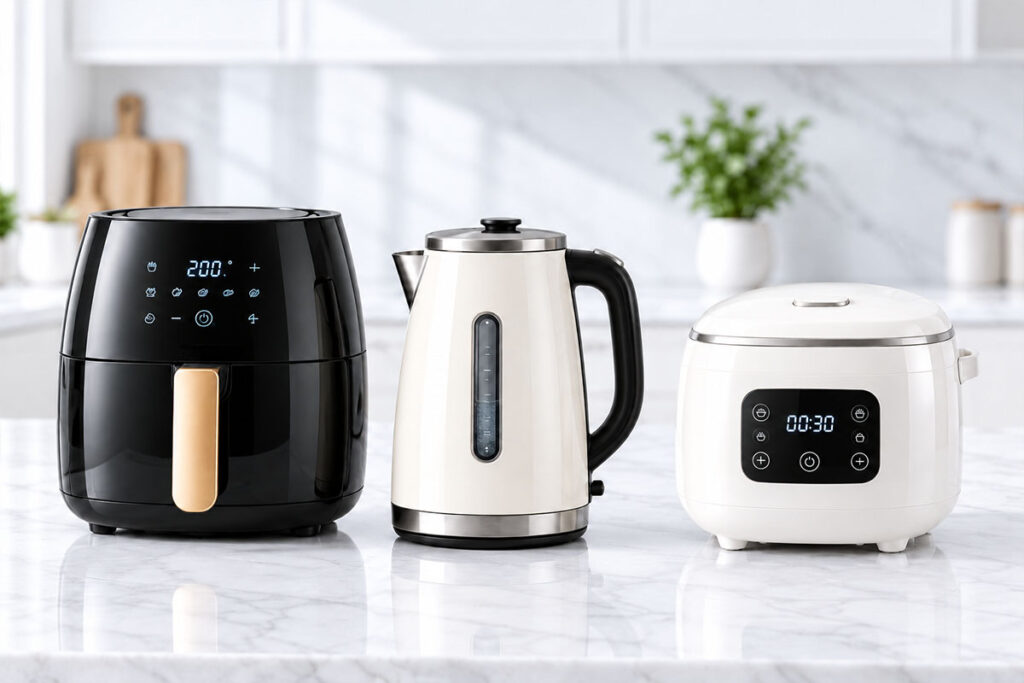
Cixi, in Ningbo, Zhejiang, is an established home appliance manufacturing hub. For importers and private-label brands, its value lies in access to a network of component suppliers, tooling businesses and appliance manufacturers.
When sourcing home appliances from Cixi, start with a practical question: can the supplier turn your product brief into an approved specification and deliver repeat orders consistently? Location helps you build a shortlist. Samples, documentation and agreed production controls help you choose a supplier.

What Cixi’s Appliance Supply Chain Offers Buyers
The Sohu article on Cixi’s appliance industry describes a manufacturing cluster built around extensive local supply chains, alongside a transition toward product development and brand building. Ningbo’s government portal also describes an industrial chain covering component design, development, processing and finished-appliance manufacturing.
For buyers, this provides a useful starting point for comparing component choices and discussing product changes. It does not establish an individual supplier’s production capacity, delivery time or quality performance.
To assess whether a supplier can use this network effectively, ask who manages each part of the order:
- Component sourcing and proposed substitutions.
- Sample preparation and revisions.
- Assembly and production coordination.
- Final inspection and release.
Responsibility should remain clear even when several businesses contribute to the product.
Define the Product Before Comparing Prices
A quotation is only useful when suppliers are pricing the same requirements. A similar appearance can conceal different motors, controls, materials, accessories or packaging.
Before requesting prices, prepare a brief that includes:
- Product type and intended use.
- Destination market and sales channel.
- Required voltage, frequency and plug.
- Main functions, dimensions and appearance.
- Branding, packaging and instruction-language requirements.
- Estimated order quantity and required delivery window.
Category-specific details also matter:
| Product category | Details to confirm before quotation |
|---|---|
| Fans | Power source, speed settings, oscillation and control method |
| Air fryers | Capacity definition, basket arrangement, controls and accessories |
| Electric heaters | Rated power, operating modes, controls and protection functions |
| Garment steamers | Water-tank capacity, power, operating positions and accessories |

Replace broad descriptions such as “premium quality” with measurable requirements. If noise matters for a fan, agree on the measurement method and operating conditions before comparing figures.
Decide How Much Customization You Need
An existing model with your branding and a product requiring new tooling have different development paths.
Branding an existing model
An existing model with branding changes may suit buyers who mainly need a logo, packaging and instructions adapted for their market. Confirm whether the proposed changes affect the existing product configuration or documentation.
Modifying an existing model
Modifying an existing model may involve controls, materials, components or accessories. Ask which changes require a revised sample, additional assessment or a different minimum order quantity.
Developing a new design
Developing a new design requires a clearer agreement on drawings, tooling, development costs, ownership and approval stages. Confirm what the supplier will deliver at each stage before committing to the project.
Labels such as OEM and ODM can be interpreted differently. The written scope should explain the actual work and responsibilities. Review our home appliance OEM, ODM and private-label options when preparing your project scope.
Compare the Complete Order Cost
Cixi’s supply-chain network is relevant to cost discussions, but buyers should compare equivalent quotations rather than assume a fixed regional saving.
Check whether each quotation includes the same:
- Product configuration and accessories.
- Retail packaging and export cartons.
- Branding and artwork preparation.
- Tooling or development charges.
- Testing and inspection arrangements.
- Trade term and named delivery location.
Packaging deserves particular attention. Confirm packed dimensions, units per carton and carton weight before estimating freight. A lower unit price may provide little benefit if the packaging creates higher transport costs or avoidable damage.
Use Samples to Establish an Approval Record
A sample should become a reference for the order, supported by a written specification.
Record the model, version, electrical configuration, materials, controls, accessories and packaging. Identify which details are final and which still require approval.
For example, if the sample has the correct appearance but a different plug or control panel, record those differences explicitly. Otherwise, the buyer and supplier may approve different interpretations of the same product.
Before production, confirm:
- The final sample and specification revision.
- Approved artwork, labels and instructions.
- Inspection checkpoints and acceptance criteria.
- How deviations and proposed changes will be resolved.
Photographs help document appearance and packaging. They should accompany any agreed functional or inspection records.
Review Documentation for the Exact Model
When a supplier provides a certificate or test report, check which model and configuration it covers. Review the model number, applicant or manufacturer details, document date and stated scope.
Ask the supplier to explain differences between the documented product and the version you intend to order. A document for another model should not be treated as evidence for your selected configuration without further review.
Plan this review early. Discovering a configuration mismatch after production can leave fewer practical options.
Build the Schedule Around Approval Milestones
Ask what starts the production lead time. Depending on the project, the starting point may be deposit receipt, sample approval, artwork confirmation or completion of another agreed condition.
Build the schedule around these milestones:
- Sample preparation and revisions.
- Artwork and documentation approval.
- Production readiness and component availability.
- Inspection, release and dispatch.
If you have a seasonal launch date, identify the latest acceptable date for each approval.
This gives both parties a clearer basis for managing delays than a single estimated delivery date.
Start Your Cixi Sourcing Project with a Clear Brief
A strong sourcing decision connects the advantages of the local supply chain with evidence about the selected product and supplier.
Qite Appliances is based in Cixi, Ningbo. Explore our home appliance range, then send your sourcing requirements with your destination market, expected quantity and preferred configuration.
A clear brief makes the first discussion more useful—and makes competing proposals easier to assess.